
How to Fix S2000 Wind Buffeting
If you've spent any time driving your S2000 with the windows down at speed, you know exactly what wind buffeting feels like - that low-frequency thumping that beats against your head. It's not painful in the way a whistle or a squeal is, but it's fatiguing, and at track speeds it gets aggressive.
There's a reason it happens, and there's a fix.
Track Days in the US: Windows Down Is the Rule
In the United States, most track day organizations and HPDE event rules require drivers to keep their windows fully down during on-track sessions. The reasoning is straightforward - in the event of a rollover or an emergency egress situation, a closed window is a barrier between you and a quick exit. Windows down keeps that escape route open.
For most cars, this is a non-issue. But the S2000's open-top geometry creates a particular aerodynamic problem when you're running without the windows up. At street speeds it's manageable. Somewhere north of 50-60 MPH, it starts to become noticeably annoying. On a track where you're holding 80, 90, or 100+ MPH through sweeping sections, it becomes a real distraction and a fatiguing one at that.
The buffeting doesn't just fill the cabin with noise. It creates a constant pressure oscillation that you feel more than hear.
Why It Happens: The A-Pillar, the B-Pillar, and the Shear Layer
The root cause comes down to the geometry of the car and what happens to airflow at the window opening.
As the freestream air hits the windshield and spills outward around the A-pillar, it gets channeled into a tight corridor between the A-pillar and the side mirror housing. That physical pinch-point acts like a nozzle - it accelerates the air. By the time that jet exits toward the window opening, it's moving significantly faster than the ambient air around the car.
Here's where the problem compounds: the B-pillar on the S2000 is wider and more rearward than the A-pillar. This means the window opening itself is relatively wide, and there's nothing to interrupt or redirect that high-velocity jet as it shoots rearward along the window line and into the open cabin.
What you end up with is a violent shear layer - a boundary between the fast-moving outside air and the relatively stagnant air trapped inside the cabin. That boundary is highly unstable. It collapses and throws vortices directly at the driver's head. That's the buffeting. It's not random turbulence; it's a predictable aerodynamic consequence of the car's geometry.
What the CFD Shows
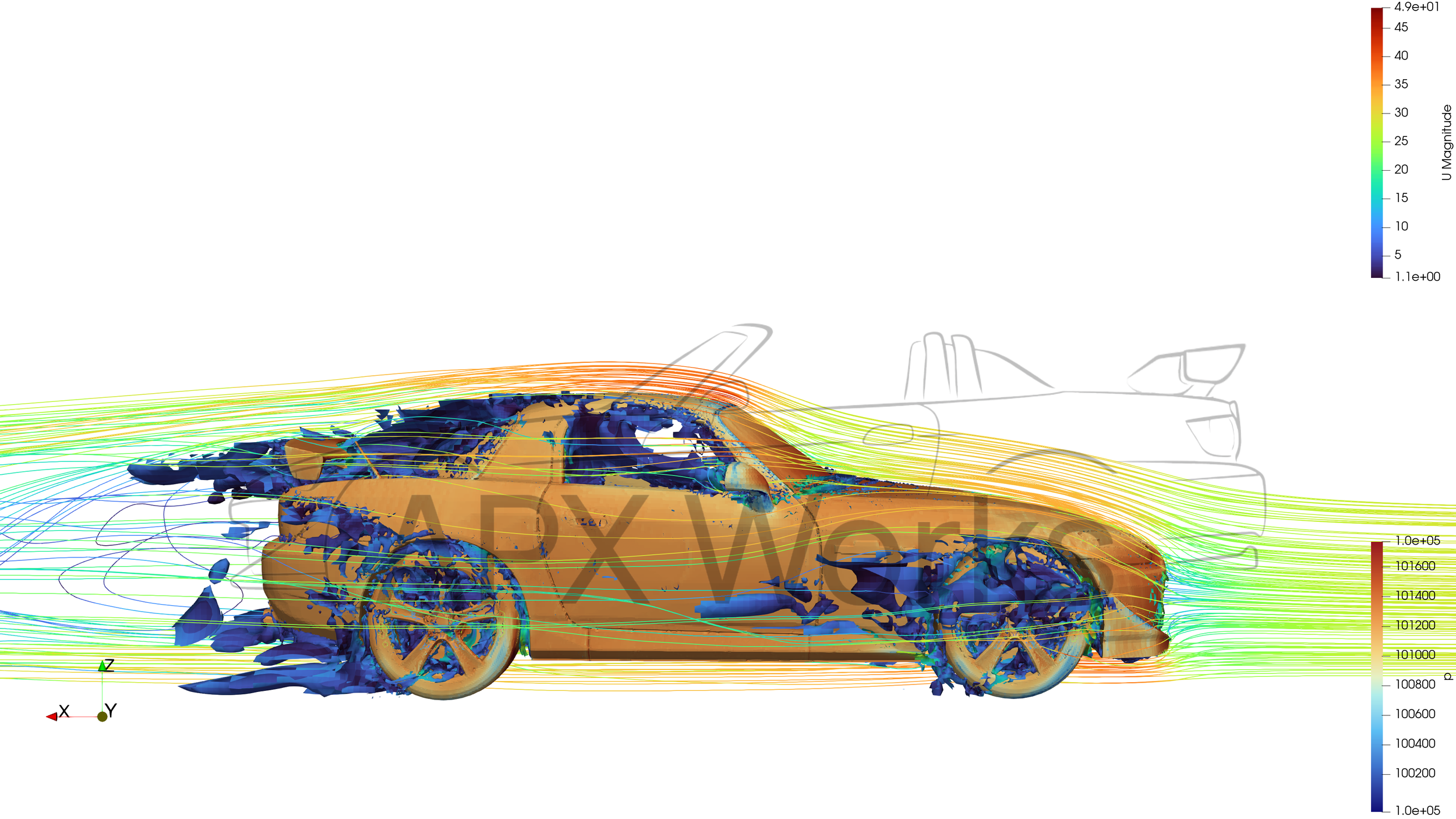
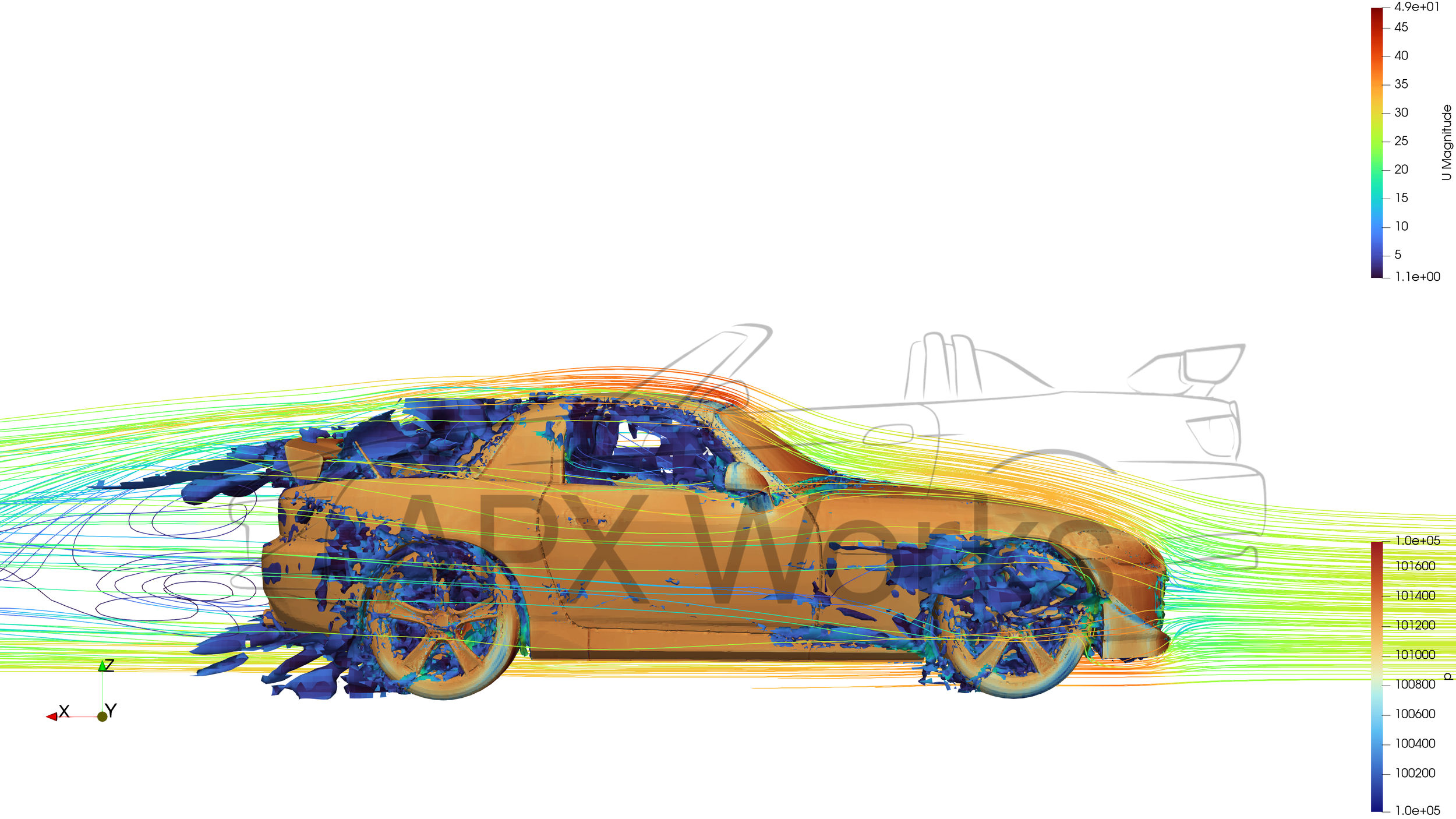
These renders are Q-criterion iso-surfaces - a way of making the vortex cores in the flow physically visible - colored by velocity magnitude using a cool-to-warm scale (blue = slow, red = fast). The camera is positioned at a rear 3/4 elevated angle looking into the open cockpit, which puts both the turbulent structures forming at the window opening and the stagnant zone inside the cabin in the same frame.
Without the deflectors, the chaotic tangle of colored volumes you see clustered around the A-pillar and window opening are the vortices being shed at the shear layer boundary. That's the instability described above, rendered in 3D. Inside the cockpit, the blue region is the slow, captured air that's no longer moving with the freestream - it's been pulled in and stalled. That's exactly where the driver's head sits. The constant collapse and reformation of that shear layer boundary is what you feel as buffeting.
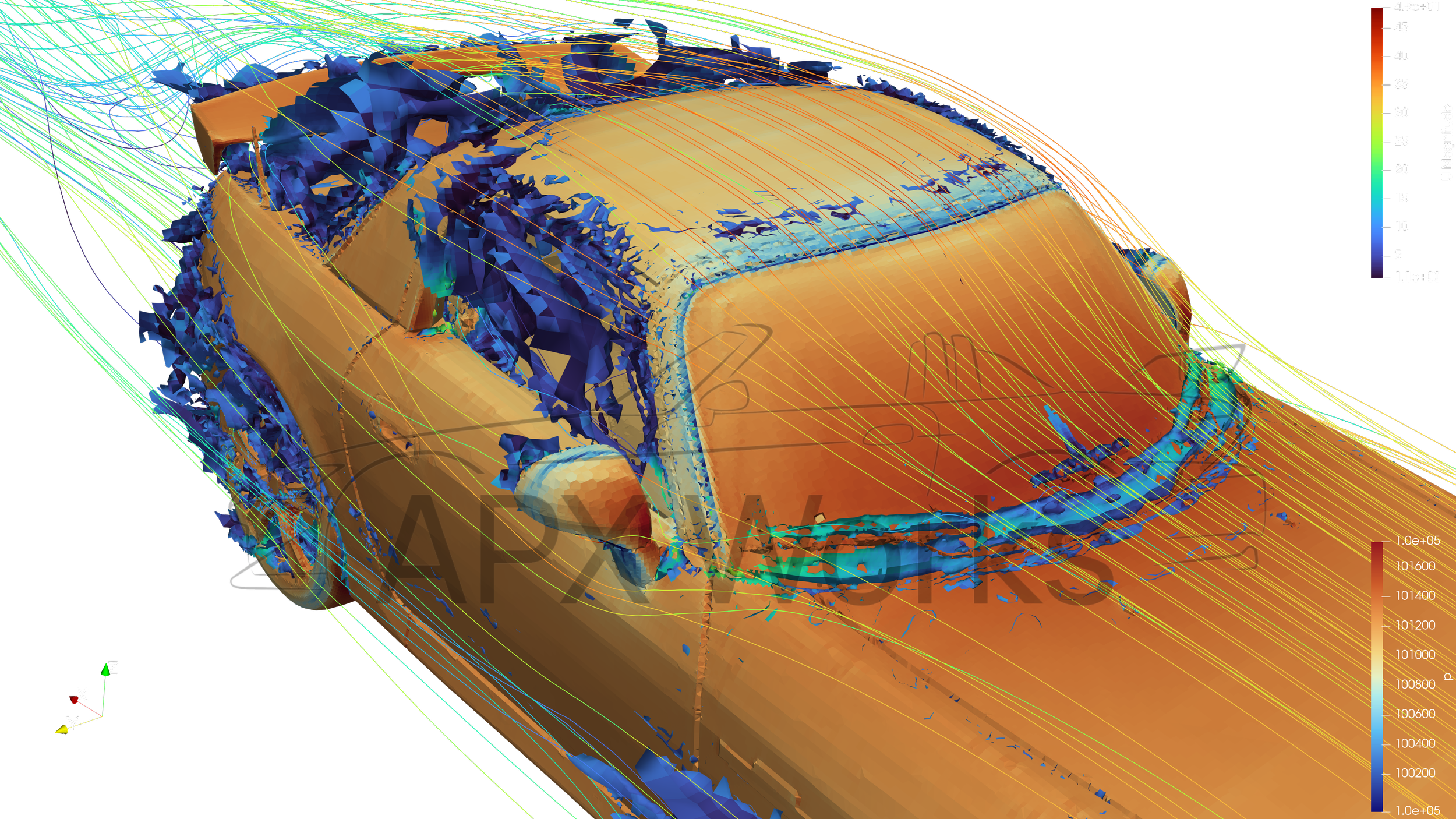
Q-criterion iso-surfaces colored by velocity magnitude show the turbulent vortex structures shedding off the window opening on the stock configuration. The blue stagnant zone inside the open cockpit is the captured air loading up against the driver.
With the APX deflectors installed, the picture shifts. The deflectors are visible as the small fins at the front of the window opening - and their effect on the vortex field is immediate. The chaotic cluster of turbulent structures that was spilling into and around the cabin opening is pushed outward. The shear layer has been displaced away from the cockpit, and the vortex activity at the window line is noticeably more organized.
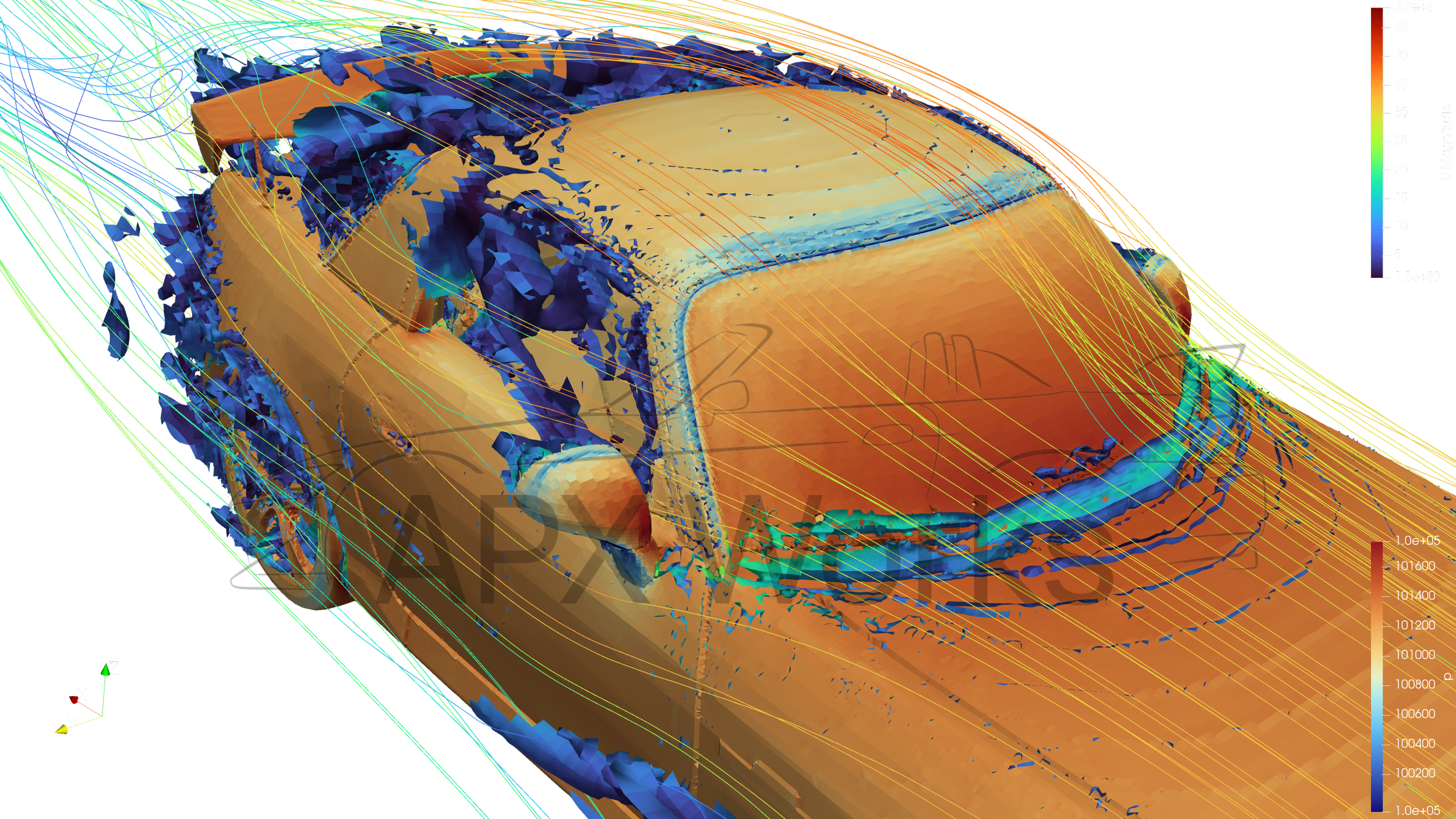
With the deflectors installed, the turbulent vortex cluster at the window opening is pushed outward and away from the cabin. Less vortex energy at the shear layer means a more stable boundary — and dramatically less buffeting.
A more stable shear layer means the boundary between outside air and cabin air stops oscillating violently. That's the buffeting going away.
For hard top users: the deflectors are also effective at reducing wind noise with the top on. Air has a tendency to find the small pocket at the rear-most edge of the window where the hardtop meets the window molding. The deflectors redirect that flow before it gets there, which addresses one of the more common wind noise complaints on AP1s and AP2s running aftermarket or OEM hard tops.
The Fix
The APX Wind Deflectors mount directly to the A-pillar using included 3M VHB double-sided tape - no drilling, no modifications. They're made from ASA Glass Fiber Reinforced material, which handles UV exposure and temperature cycles without warping or fading. Sold as a pair.
If you're running track days, this is one of the more impactful quality-of-life upgrades you can make to the car. The data backs it up, and the difference is immediately noticeable the first time you get above 70 MPH with them installed.